Biological Clock Effects on Decision Accuracy in Worldwide Digital Table Game Marathons
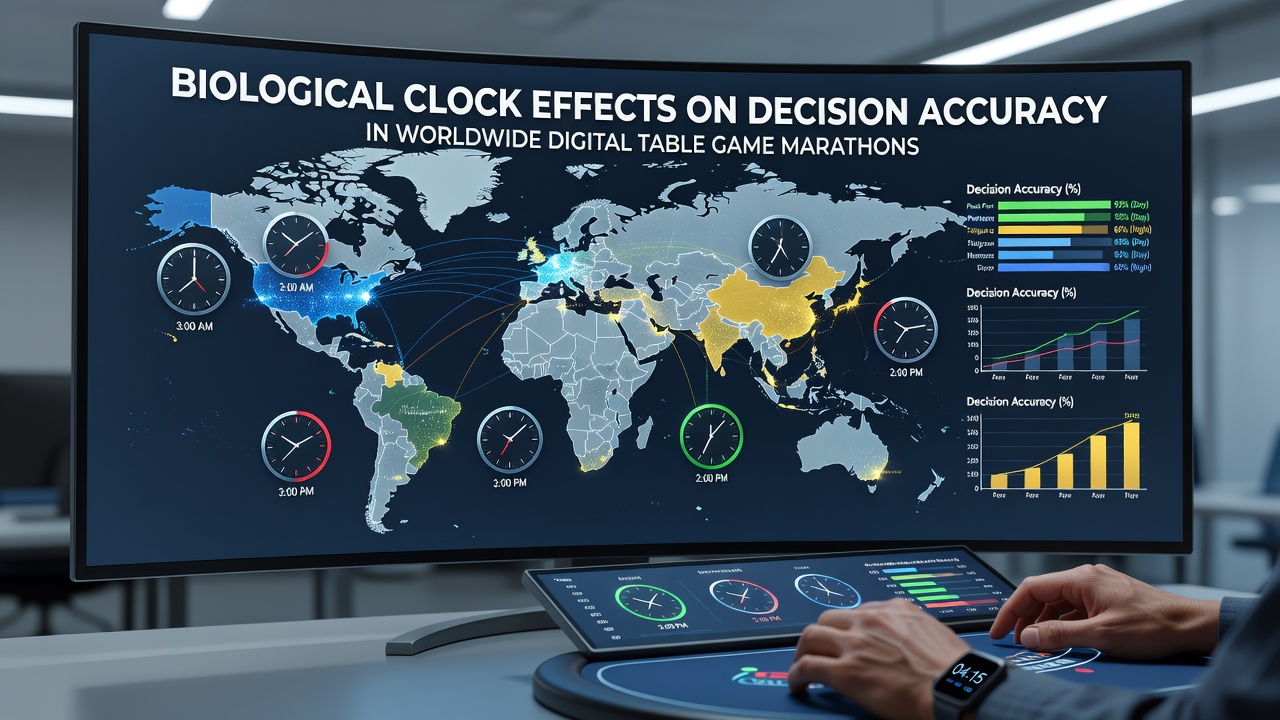
Digital table game marathons draw participants from every continent, and their biological clocks continue to operate on local schedules even as events stretch across days and nights. Circadian rhythms regulate alertness, reaction speed, and risk assessment, which means decision accuracy fluctuates according to each player's internal timing rather than the tournament clock. Researchers tracking performance data have documented measurable declines in strategic choices during periods that conflict with normal sleep-wake cycles, particularly when sessions cross midnight in multiple time zones simultaneously.
Circadian Rhythms and Cognitive Performance Metrics
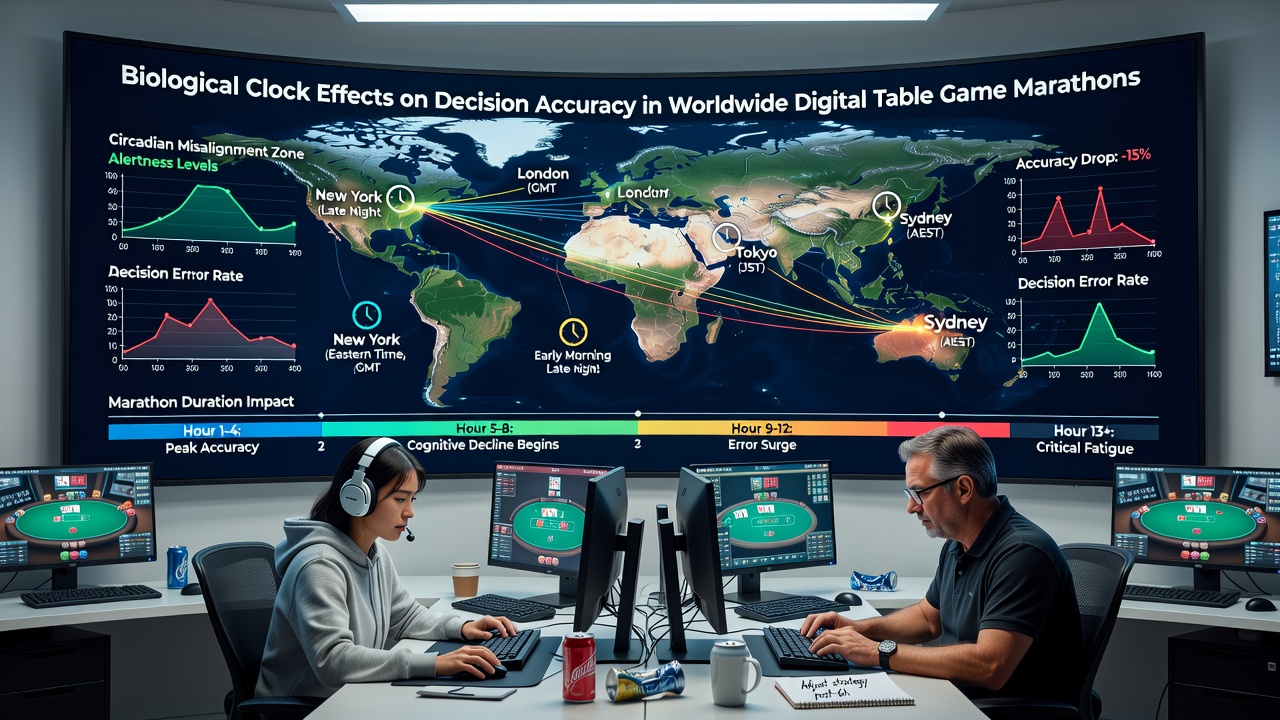
Core body temperature, melatonin levels, and cortisol release follow predictable daily patterns that influence attention and memory retrieval. When players remain active during their biological night, studies show slower processing of hand ranges and increased likelihood of deviating from established strategies. Data collected from large-scale online platforms indicate that error rates in probability calculations rise by measurable percentages after 18 consecutive hours of play, with sharper increases recorded among those whose local time corresponds to habitual sleep periods. Observers note these patterns hold steady across different game variants, suggesting the effect stems from physiological timing rather than game-specific rules.
Global Time Zone Interactions in Extended Events
Worldwide marathons scheduled in June 2026 highlighted the scale of these interactions, as registration logs revealed thousands of entrants competing from regions spanning 12 or more hours apart. Players located in Asia-Pacific zones often reached critical decision points during their afternoon peak alertness while opponents in the Americas operated near their circadian trough. Platform analytics revealed clusters of suboptimal folds and calls concentrated in the early morning hours for North American participants, whereas European players showed parallel patterns shifted by their own time offsets. Mapping software used by tournament organizers now overlays participant locations with performance timestamps, producing visualizations that link decision accuracy directly to each region's solar cycle.
Evidence from Platform Data and Research Initiatives
Longitudinal tracking conducted through major digital networks demonstrates that multi-day events produce distinct accuracy curves aligned with aggregate circadian profiles. One analysis of elimination-stage choices found that participants logging in during their subjective evening maintained tighter hand ranges compared with those active during subjective morning hours, even when total hours played remained constant. Researchers affiliated with academic institutions have begun integrating wearable sleep data into these studies, confirming correlations between reduced REM cycles and elevated variance in betting decisions. Figures released by the National Center for Biotechnology Information further support connections between sleep pressure and executive function decline in sustained cognitive tasks.
Regional Patterns and Retention Observations
Retention statistics compiled across different continents reveal that players who align their participation windows with peak circadian alertness maintain longer session durations before accuracy metrics drop. In contrast, those forced into off-peak hours by fixed tournament schedules exhibit earlier exits tied to accumulated errors rather than stack depletion alone. Australian and Canadian regulatory summaries from 2025-2026 events document similar geographic clustering, where local midnight crossings coincide with spikes in reported misclicks and timeout forfeits. These patterns emerge consistently whether events run on centralized servers or distributed regional nodes, underscoring the dominance of individual biological timing over platform architecture.
Measurement Approaches Used by Analysts
Operators employ decision-logging tools that timestamp each action against player-provided location data, enabling calculation of circadian phase for every participant. Metrics such as fold-to-raise ratios, continuation bet frequencies, and all-in call accuracy are then stratified by hours since each individual's typical wake time. Results indicate a consistent nadir in performance roughly 4-6 hours after local midnight, independent of total sleep debt accumulated during the marathon. European research consortia have replicated these findings using controlled subsets of players who maintained consistent pre-event sleep schedules, isolating circadian phase as teh primary variable.
Conclusion
Platform operators and researchers continue to refine scheduling tools that account for aggregate circadian distributions among global entrants. Accuracy data collected through June 2026 events and prior series demonstrate that biological timing exerts measurable influence on decision quality throughout extended digital table game marathons, producing patterns observable across continents and game formats. Continued integration of timing analytics with performance records provides clearer mapping of these effects for future event structures.