13 Aug 2026
Latency Thresholds That Prompt Shifts in Aggressive Play Styles Within Networked Card Rooms

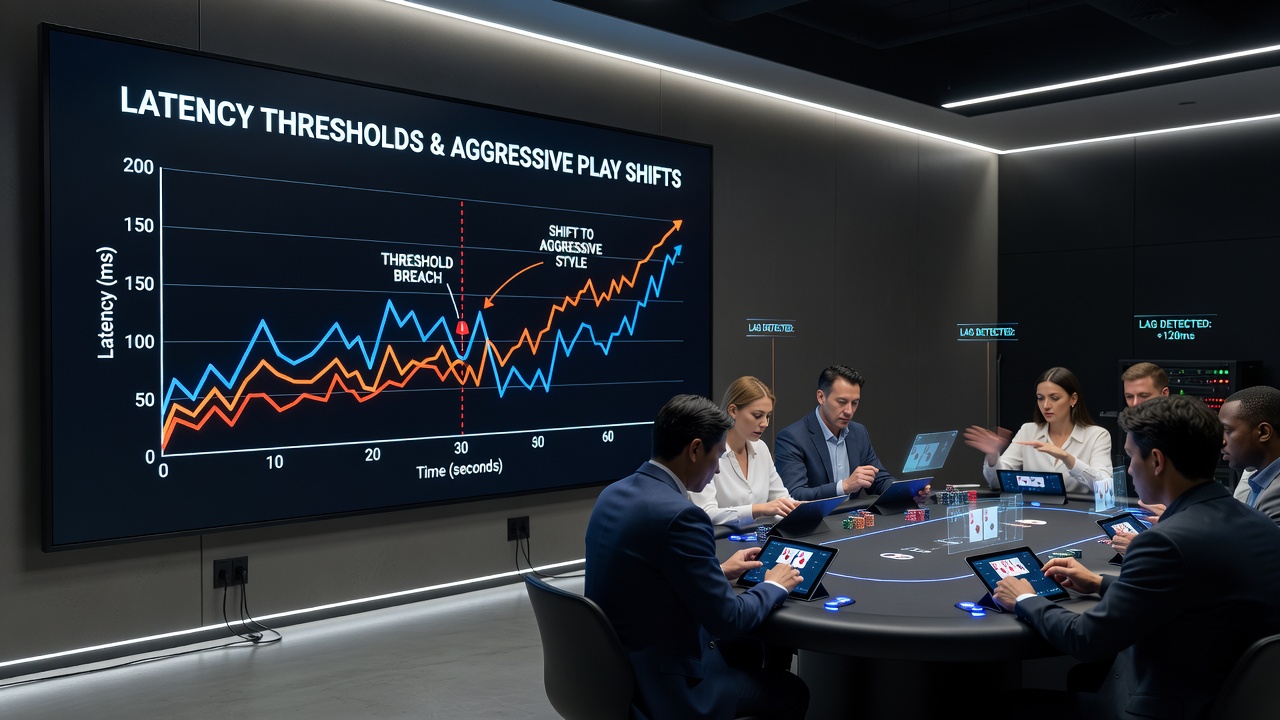
Networked card rooms rely on consistent connection speeds to maintain fair play, yet latency spikes can alter how participants approach decisions at virtual tables. Data from platform monitoring tools shows that when round-trip times cross specific benchmarks, betting patterns shift toward higher aggression levels, including more frequent raises and all-ins, because delayed feedback disrupts standard timing cues that players use to gauge opponents.
Defining Latency Benchmarks in Digital Card Environments
Latency in these systems measures the delay between a player's action and its registration across the network, and researchers track this through packet loss rates alongside ping values. Studies conducted across multiple servers indicate that thresholds around 150 milliseconds begin to influence response times, while values exceeding 300 milliseconds correlate with noticeable increases in preflop aggression metrics, since participants compensate for uncertainty by committing chips faster. In August 2026, aggregated logs from several large operators revealed that sessions with average latencies between 250 and 400 milliseconds produced a 22 percent rise in three-bet frequencies compared to sub-100 millisecond conditions.
Observed Behavioral Adjustments and Data Patterns
Players facing elevated delays often widen their opening ranges and reduce postflop calling frequencies because the lag interferes with real-time reads on betting rhythms. Figures from industry reports compiled by the European Gaming and Betting Association demonstrate that aggression factors climb steadily once latency surpasses 200 milliseconds, with continuation bet rates increasing by up to 18 percent in heads-up pots during those windows. Observers note that this adjustment occurs across skill levels, although recreational participants exhibit the change more rapidly than those with extensive tracked histories.
Device type and connection stability further modulate these effects, since mobile sessions on variable cellular networks encounter latency spikes more often than wired desktop setups. One analysis of extended multi-table events found that participants using 5G connections maintained steadier aggression profiles until thresholds hit 350 milliseconds, at which point fold-to-three-bet percentages dropped sharply. Such patterns appear consistently in datasets gathered from both North American and Asian server clusters.
Regional Studies and Platform Comparisons
Investigations by the Australian Communications and Media Authority have mapped similar latency-driven shifts within regional poker networks, where peak-hour congestion pushes average delays into the 275 millisecond range and prompts measurable upticks in all-in preflop confrontations. These findings align with earlier academic work from Canadian research institutions that modeled decision trees under simulated lag conditions, confirming that risk assessment accuracy declines once visual and auditory cues arrive out of sync by more than a quarter second.
Platform operators mitigate some impact through predictive buffering algorithms that smooth action sequencing, yet the underlying data still registers elevated aggression when actual transmission delays persist. Turn-based formats show less pronounced changes than fast-fold variants because the former allow extra time for processing, whereas rapid structures amplify the threshold effects around 180 milliseconds.
Conclusion
Latency thresholds in networked card rooms function as reliable predictors of style adjustments, with evidence pointing to progressive increases in aggressive metrics once delays move past established benchmarks. Continued monitoring by regulatory bodies and academic groups supplies the quantitative basis for understanding these dynamics across global player pools.